Vera C. Rubin Observatory Reveals Breathtaking Sagittarius Starfield Near Galactic Core


Astro Information
Vera C. Rubin Observatory Reveals Breathtaking Sagittarius Starfield Near Galactic Core

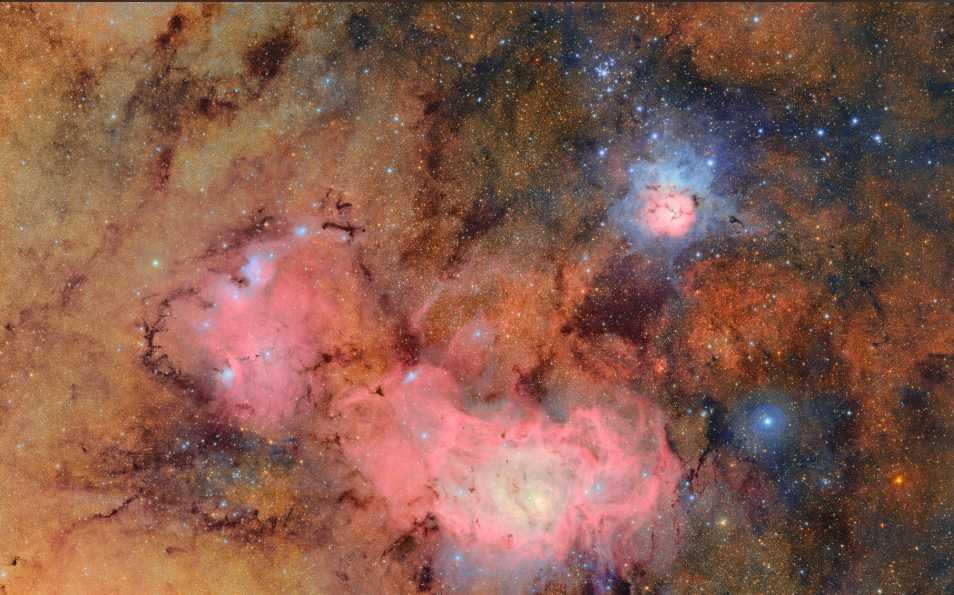
The Vera C. Rubin Observatory, a joint project of the NSF and DOE, has released one of its first images: a 4-degree-wide starfield spanning Sagittarius, showcasing the crowded stellar backdrop toward the Milky Way’s core. The snapshot captures iconic nebulae and clusters, including Messier 8 (the Lagoon Nebula) and Messier 20 (the Trifid Nebula), in stunning detail.

A Cosmic Tapestry of Stellar Nurseries and Galactic Architecture

The image’s focal points, M8 and M20, are vibrant stellar nurseries located ~5,200 and ~5,900 light-years away, respectively. M8’s pink hue stems from ionized hydrogen gas energized by young O-type stars, while its central "Hourglass" structure reveals regions of active star birth. M20, divided by dark dust lanes into three lobes, glows from both hydrogen emission and blue light reflected by interstellar dust, hosting the massive star system IRS 4.


The field also includes numerous open clusters and faint nebulae, all set against the dense stellar population of the galactic bulge. Rubin’s 3.2-billion-pixel camera—the largest ever built for astronomy—resolved subtle gas filaments and individual stars, demonstrating the telescope’s capacity to capture both nearby wonders and distant cosmic features.

Scientific Significance: Paving the Way for Galactic and Extragalactic Discoveries

This image marks the beginning of Rubin’s Legacy Survey of Space and Time (LSST), which will monitor the sky for a decade to study dark matter, dark energy, and transient events. For galactic astronomers, the Sagittarius field offers a window into the Milky Way’s central regions, where stellar populations and interstellar gas dynamics provide clues to the galaxy’s formation.


"Rubin’s first light in Sagittarius shows how its revolutionary camera can reveal both the beauty and complexity of our cosmic neighborhood," said Dr. Heidi Hammel, project scientist. "As LSST progresses, we’ll uncover millions of stars and galaxies, transforming our understanding of the universe’s evolution."


With its combination of breadth and resolution, the image exemplifies how Rubin Observatory will bridge the gap between local stellar systems and the farthest reaches of the cosmos—one 4-degree slice of the sky at a time.
Latest Stories
Feline News2 minute readOriginating from the northwestern United States, the Pixiebob Longhair has captivated cat enthusiasts worldwide with its striking resemblance to the wild bobcat and its loyal, affectionate nature. As the long-haired variant of the Pixiebob breed, this "native new breed"—recognized by The International Cat Association (TICA)—boasts a robust physique, luxurious silky coat, and a uniquely bobbed tail, earning accolades in international cat shows.
Animal Information1 minute readOriginating in Hungary, the Komondor is a muscular large breed renowned as a fearless guardian. Historically tasked with protecting herds from wolves, this agile canine now serves as a devoted family guard dog, blending loyalty with a distinctive appearance that earned it a quirky nickname.
Feline News2 minute readThe Turkish Angora, a breed steeped in history and elegance, has captivated hearts for centuries with its striking appearance and regal demeanor. Originating from Ankara, Turkey (formerly Angora), this ancient longhair breed is believed to be the ancestor of many modern longhaired cats. Once on the brink of extinction, it was saved by dedicated conservation efforts, including a 1930s breeding program initiated by the Turkish government, which focused on preserving the iconic white-coated variety. Today, it stands as a national treasure, celebrated for its beauty and cultural significance.
Animal Information1 minute readThe humphead wrasse (Cheilinus undulatus), a majestic marine species, remains listed as endangered, facing ongoing threats to its survival in global oceans. Renowned for its impressive size, adult individuals can reach a staggering weight of 180 kilograms, making it one of the largest reef-dwelling fish in the world.
Feline News1 minute readThe Balinese cat, also known as the Bali cat or Java cat, is a charming medium - sized long - haired cat. It originated in the United States and is a long - haired mutant of the Siamese cat. It is named the Balinese cat because its movements are 酷似 those of the native Balinese dancers.
Animal Information1 minute readThe global population of Bengal tigers currently stands at approximately 24,000, but a closer look at the figures reveals a worrying reality: only around 3,200 of these majestic creatures live in their natural wild habitats, while nearly 20,000 are in captivity. This stark contrast becomes even more alarming when compared to historical records.
Animal Information1 minute readThe Atossa fritillary (Speyeria adiaste atossa), a butterfly once common in Southern California’s mountain regions, is feared extinct, with no confirmed sightings since 1959. Characterized by its broad wings decorated with elegant black spots, the species once thrived across the area’s rugged landscapes.