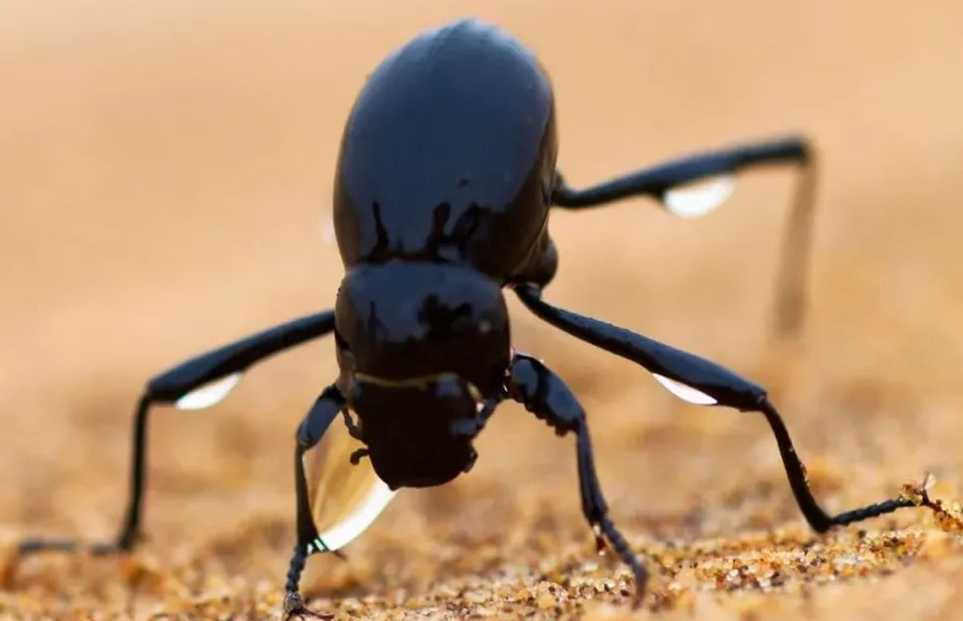
The Namib Desert beetle, Stenocara gracilipes, stands as a testament to evolutionary adaptation in one of Earth’s harshest environments. This coleopteran insect, endemic to the Namib Desert of southwestern Africa, has evolved a remarkable survival strategy: harvesting fog droplets through its uniquely textured elytra, a trait that has inspired groundbreaking biomimetic water-collection technologies.
The Namib Desert Beetle (Stenocara gracilipes): Nature's Master of Fog Harvesting
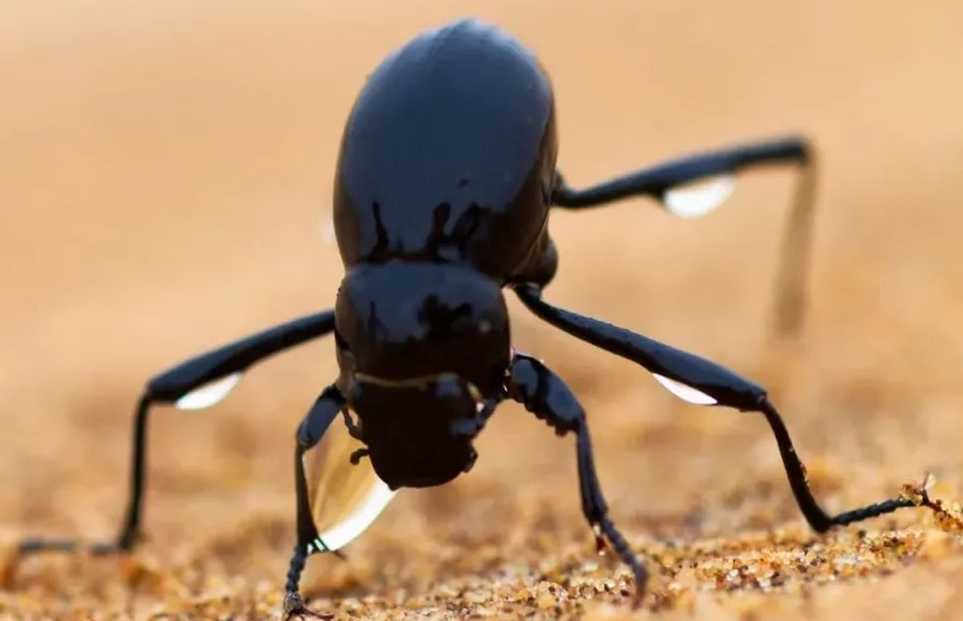
The Namib Desert beetle, Stenocara gracilipes, stands as a testament to evolutionary adaptation in one of Earth’s harshest environments. This coleopteran insect, endemic to the Namib Desert of southwestern Africa, has evolved a remarkable survival strategy: harvesting fog droplets through its uniquely textured elytra, a trait that has inspired groundbreaking biomimetic water-collection technologies.
Source: Images from the Internet, if there is any infringement, please contact the removal of
Physical Adaptations for Aridity
Measuring approximately 2 cm in length, Stenocara gracilipes boasts a flattened, dark exoskeleton that withstands desert heat. Its most extraordinary feature is the elytral surface, covered in a matrix of hydrophilic bumps (0.5 mm diameter) separated by hydrophobic valleys. The bumps, lacking the waxy coating of the valleys, attract water molecules, while the valleys—coated in a lotus-like, wax-based hydrophobic layer—repel them. This binary surface creates a natural water-collection system: when fog rolls in from the Atlantic Ocean, droplets condense on the hydrophilic bumps, coalesce, and slide down the hydrophobic valleys toward the beetle’s mouth.
Survival in the Desert Fog
The Namib Desert, one of the world’s driest regions, experiences frequent coastal fogs due to the cold Benguela Current. Each morning, Stenocara assumes a head-down, tail-up posture, orienting itself to face the fog. Its elytra act as living condensers: in optimal conditions, the beetle can collect up to 40% of its body weight in water daily. This adaptation allows it to thrive where liquid water is scarce, demonstrating nature’s ingenuity in arid survival.
Biomimicry: From Beetle to Technology
Inspired by Stenocara’s elytral structure, scientists have developed superhydrophobic-hydrophilic hybrid materials. For example, researchers have created fog-collecting nets and panels with bump-valley microtextures, mimicking the beetle’s surface to condense and channel water. These technologies—used in desert water catchment systems, self-filling water bottles, and even architectural designs—offer sustainable solutions for water-scarce regions. The beetle’s “air-to-water” strategy has also influenced the design of fog-harvesting tents and roofing tiles, proving that nature’s oldest engineers still hold the key to modern challenges.
Through millions of years of evolution, Stenocara gracilipes has turned desert fog into a lifeline—a feat that continues to shape innovations in materials science and water conservation. Its story exemplifies how extreme environments breed extreme solutions, blurring the line between biology and technology.