Jupiter’s Cosmic Wonders Unveiled by Juno: From Swirling Clouds to a Mysterious Core


Astro Information
Jupiter’s Cosmic Wonders Unveiled by Juno: From Swirling Clouds to a Mysterious Core

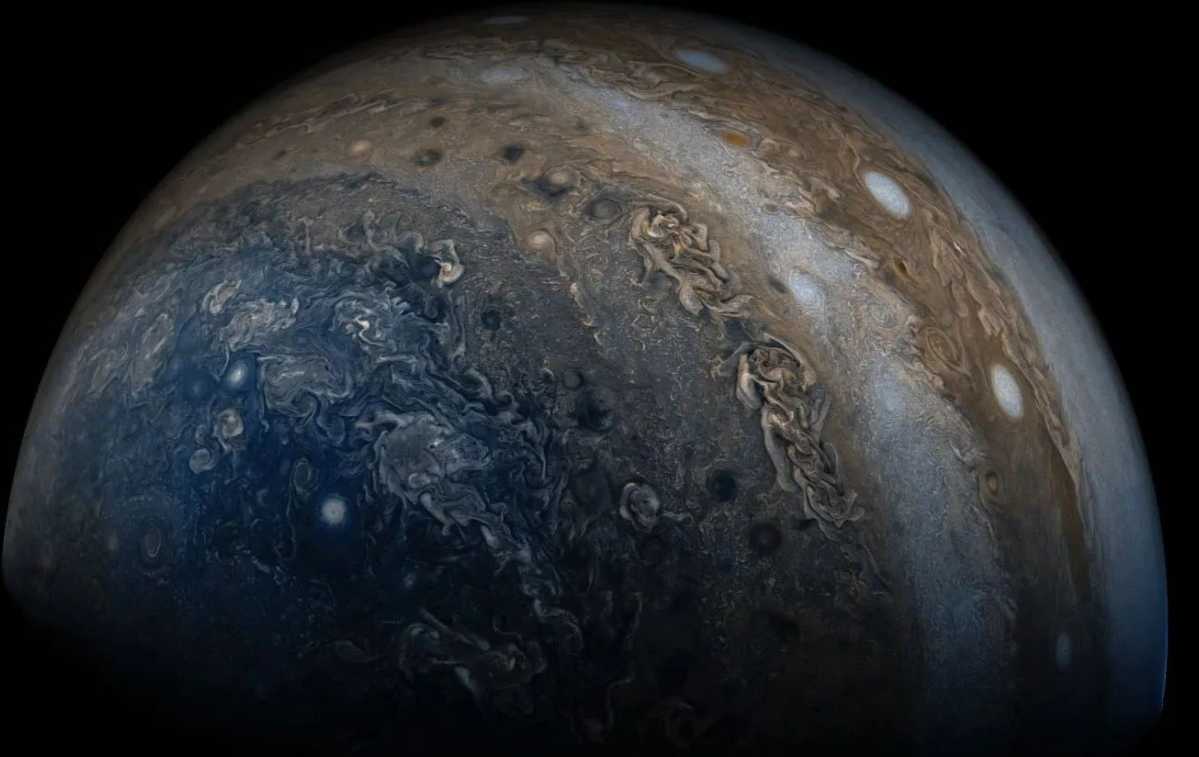
NASA’s Juno spacecraft, on its highly elliptical orbit around Jupiter, has completed over 70 close flybys, revealing the gas giant’s secrets. A 2017 image captured from below Jupiter’s equator shows horizontal cloud bands transforming into spectacular swirling vortices and intricate patterns, with a "string of pearls" array of white oval cloud formations near the equator. These views challenge all prior conceptions of Jupiter’s atmospheric dynamics.

Juno’s Revelations: A World Beyond Surface Storms

Juno’s data confirms Jupiter’s weather systems plunge thousands of kilometers below the cloud tops, far deeper than previously thought. The spacecraft’s gravity measurements hint at a massive, "squishy" core—likely a mix of dense fluids rather than a solid mass—and its magnetic field displays dramatic regional variations, with some poles stronger than others.


"A key surprise is how Jupiter’s interior flows interact with its magnetic field," says Dr. Scott Bolton, Juno’s principal investigator. "The planet’s core isn’t a static lump but a dynamic system shaping its global properties."

Juno’s Inevitable Destiny: A Fatal Dive into Jupiter’s Atmosphere

Scheduled to operate until 2025, Juno will eventually execute a controlled descent into Jupiter’s atmosphere, disintegrating to prevent contamination of its potentially habitable moons. The mission’s legacy extends beyond stunning imagery: it has rewritten models of gas giant formation, shown how deep storms influence planetary rotation, and provided clues to Jupiter’s role in shaping the solar system’s history.


As Juno continues its final orbits, each flyby adds to a dataset that may one day help scientists understand if other gas giants in the galaxy harbor similar complexities. For now, its images of Jupiter’s roiling clouds serve as a reminder of the cosmos’ boundless ability to astonish—even in our own cosmic backyard.
Latest Stories
Feline News2 minute readOriginating from the northwestern United States, the Pixiebob Longhair has captivated cat enthusiasts worldwide with its striking resemblance to the wild bobcat and its loyal, affectionate nature. As the long-haired variant of the Pixiebob breed, this "native new breed"—recognized by The International Cat Association (TICA)—boasts a robust physique, luxurious silky coat, and a uniquely bobbed tail, earning accolades in international cat shows.
Animal Information1 minute readOriginating in Hungary, the Komondor is a muscular large breed renowned as a fearless guardian. Historically tasked with protecting herds from wolves, this agile canine now serves as a devoted family guard dog, blending loyalty with a distinctive appearance that earned it a quirky nickname.
Feline News2 minute readThe Turkish Angora, a breed steeped in history and elegance, has captivated hearts for centuries with its striking appearance and regal demeanor. Originating from Ankara, Turkey (formerly Angora), this ancient longhair breed is believed to be the ancestor of many modern longhaired cats. Once on the brink of extinction, it was saved by dedicated conservation efforts, including a 1930s breeding program initiated by the Turkish government, which focused on preserving the iconic white-coated variety. Today, it stands as a national treasure, celebrated for its beauty and cultural significance.
Animal Information1 minute readThe humphead wrasse (Cheilinus undulatus), a majestic marine species, remains listed as endangered, facing ongoing threats to its survival in global oceans. Renowned for its impressive size, adult individuals can reach a staggering weight of 180 kilograms, making it one of the largest reef-dwelling fish in the world.
Feline News1 minute readThe Balinese cat, also known as the Bali cat or Java cat, is a charming medium - sized long - haired cat. It originated in the United States and is a long - haired mutant of the Siamese cat. It is named the Balinese cat because its movements are 酷似 those of the native Balinese dancers.
Animal Information1 minute readThe global population of Bengal tigers currently stands at approximately 24,000, but a closer look at the figures reveals a worrying reality: only around 3,200 of these majestic creatures live in their natural wild habitats, while nearly 20,000 are in captivity. This stark contrast becomes even more alarming when compared to historical records.
Animal Information1 minute readThe Atossa fritillary (Speyeria adiaste atossa), a butterfly once common in Southern California’s mountain regions, is feared extinct, with no confirmed sightings since 1959. Characterized by its broad wings decorated with elegant black spots, the species once thrived across the area’s rugged landscapes.