The Core Processes of Star Formation: Gravity and Gas in Cosmic Ballet
Stars emerge from dense molecular clouds (composed mainly of hydrogen molecules and dust), with their formation unfolding in critical stages:
Stars emerge from dense molecular clouds (composed mainly of hydrogen molecules and dust), with their formation unfolding in critical stages:
Source: Images from the Internet, if there is any infringement, please contact the removal of
- Initial Conditions: Molecular clouds balance self-gravity, magnetic fields, and turbulent pressure. When a cloud’s mass exceeds the Jeans mass (20–1,000 solar masses, dependent on temperature/density), gravity overcomes gas pressure, initiating collapse.
- Dust’s Role: Dust grains act as "cosmic nuclei," reducing cloud temperature via heat absorption/radiation, enhancing gravitational instability.
- Collapsing Core: A protostar forms first at the cloud’s center, surrounded by a rotating accretion disk. Material falls toward the core, releasing gravitational energy that heats the protostar.
- Outflows and Jets: High-speed jets (e.g., Herbig-Haro objects) erupt from the protostar’s poles, while stellar winds at the disk’s edge disperse surrounding gas, preventing excessive accretion.
When the protostar’s core temperature exceeds 10 million K, hydrogen fusion to helium begins, launching the star into the main sequence. Radiation pressure balances gravity, stabilizing the celestial body.
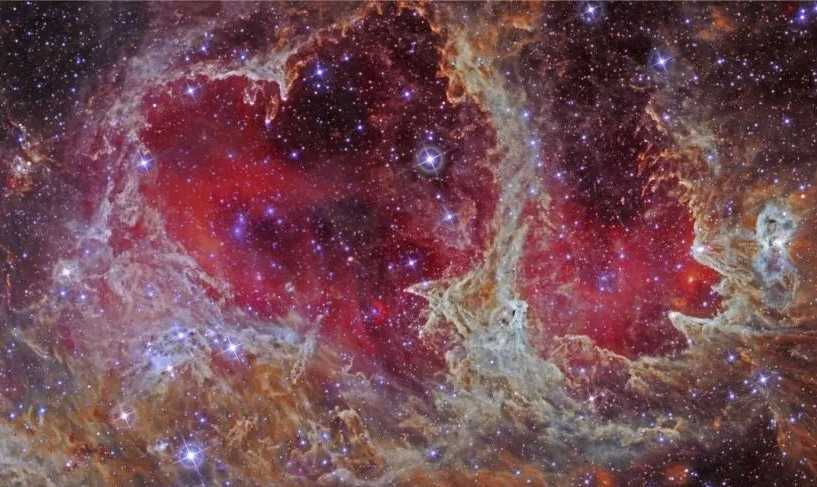
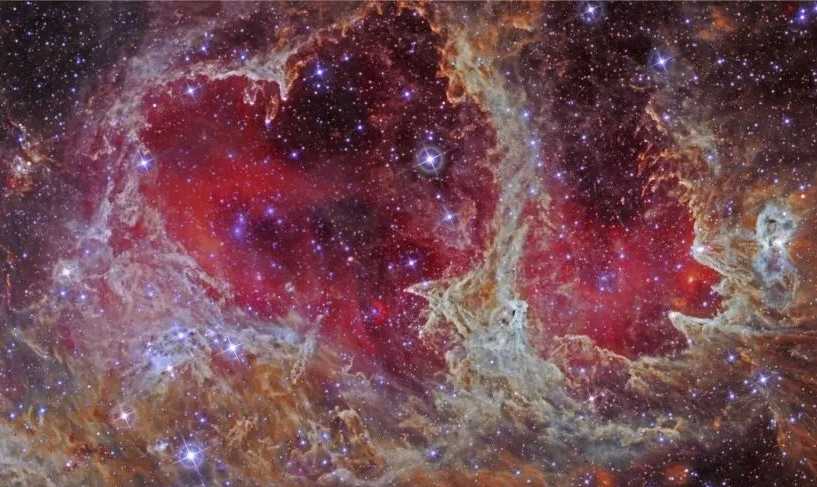
NASA’s NEOWISE satellite (formerly WISE) captured the W5 region (6,500 light-years away) in infrared, revealing the trigger mechanism of star formation:
- W5 harbors a 50-light-year-wide giant hollow with massive stars (e.g., O-type stars) at its center, forming 1–2 million years earlier than edge stars.
- Cause: Massive stars have short lifespans (millions of years). Their intense UV radiation, stellar winds, and eventual supernovae "carve out" the hollow.
- Compression by Outflowing Gas: Hot outflows from central stars (hundreds of km/s) collide with surrounding cold molecular clouds (10–20K), compressing gas into dense clumps (density >10⁴ molecules/cm³).
- Chain Reaction of Gravitational Collapse: Compressed clumps meet Jeans instability criteria, collapsing to form new stars. W5’s edge hosts young stars (1–0.5 million years old), creating an "old center, young edge" age gradient.
- Visible light is blocked by dust, but NEOWISE’s infrared bands (3.4–22 microns) penetrate it, revealing:
- Red glows: Heated dust (from stellar radiation);
- Blue : Newborn stars (hotter, stronger infrared emission).
W5 exemplifies the self-propagating mechanism of star formation: massive stars are both "star makers" and "space cleaners." Their activity shapes the interstellar medium, driving next-generation star birth, as seen in:
- Orion Nebula: The central Trapezium cluster’s winds compress surrounding gas, forming "star nurseries."
- Eagle Nebula’s 'Pillars of Creation': Shockwaves from supernovae trigger protostars within the pillars.
Data from NEOWISE and other telescopes (e.g., W5’s infrared spectra) supports theoretical models:
- Computer Simulations: Hydrodynamic models replicate outflow gas compression, matching W5’s hollow-edge structure.
- Cluster Age Distribution: The 1.5-million-year age gap between W5’s central and edge stars aligns with the time scale of massive-star-triggered formation.
Conclusion: Star birth is not just a physical process of gravity and gas but a pivotal link in the universe’s matter-energy cycle. From W5’s "cosmic seagull" to the Milky Way’s hundred billion stars, each stellar birth continues the epic of galactic evolution. Infrared telescopes are unveiling the mysteries of this cosmic "origin story"—a testament to the universe’s enduring capacity for creation.