The Leatherback Turtle: Earth’s Colossal Marine Reptile Without a Traditional Shell


Animal Information
The Leatherback Turtle: Earth’s Colossal Marine Reptile Without a Traditional Shell

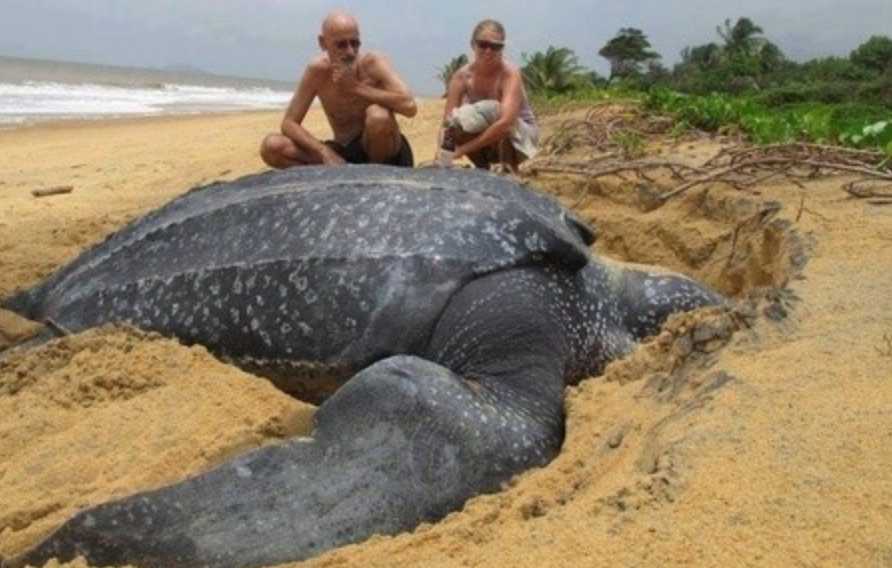
The leatherback turtle (Dermochelys coriacea) holds the title of the world’s largest turtle, capable of weighing up to 900 kilograms. Unlike other turtles, it lacks a hard bony shell. Instead, its back is supported by a flexible framework of bones covered by thick, rubbery skin, giving it a unique, leathery appearance that distinguishes it from all other chelonians.

An Evolutionary Marvel: Adaptations for Oceanic Life

  • Shell Structure Redefined
    The leatherback’s "shell" is a mosaic of bony plates beneath dark, pebbled skin, topped by seven longitudinal ridges. This design reduces drag in water, allowing it to dive to depths of over 1,000 meters—deeper than any other turtle. Its body is streamlined for transoceanic journeys, with flippers spanning up to 2.7 meters, enabling it to migrate thousands of kilometers each year.
  • Thermoregulation Superpowers
    As a semi-endothermic animal, the leatherback maintains body heat in cold oceans through adaptations like a thick layer of fat and efficient blood vessel arrangements. This allows it to thrive in waters where other turtles would freeze, making it a true master of extreme environments.

Global Wanderer and Conservation Concerns

  • Diet and Life Cycle
    Primarily feeding on jellyfish, the leatherback plays a crucial role in controlling jellyfish populations. Females return to tropical beaches to nest, digging pits and laying up to 100 eggs per clutch. Hatchlings face numerous threats, from predatory crabs to artificial lighting that disorients them from the sea.
  • Threats to Survival
    Listed as "Vulnerable" by the IUCN, the leatherback confronts multiple perils: plastic pollution (mistaken for jellyfish), habitat loss from coastal development, and climate change (which skews egg sex ratios). Fishing gear entanglement also poses a significant risk, with thousands dying annually in commercial nets.


Despite its massive size and ancient lineage (dating back 100 million years), the leatherback’s future hinges on human action. Conservation initiatives—including beach patrols, net modifications, and plastic reduction campaigns—aim to protect this ocean giant, ensuring that Earth’s last leatherback turtles continue to traverse the world’s seas for generations to come.
Latest Stories
Feline News2 minute readOriginating from the northwestern United States, the Pixiebob Longhair has captivated cat enthusiasts worldwide with its striking resemblance to the wild bobcat and its loyal, affectionate nature. As the long-haired variant of the Pixiebob breed, this "native new breed"—recognized by The International Cat Association (TICA)—boasts a robust physique, luxurious silky coat, and a uniquely bobbed tail, earning accolades in international cat shows.
Animal Information1 minute readOriginating in Hungary, the Komondor is a muscular large breed renowned as a fearless guardian. Historically tasked with protecting herds from wolves, this agile canine now serves as a devoted family guard dog, blending loyalty with a distinctive appearance that earned it a quirky nickname.
Feline News2 minute readThe Turkish Angora, a breed steeped in history and elegance, has captivated hearts for centuries with its striking appearance and regal demeanor. Originating from Ankara, Turkey (formerly Angora), this ancient longhair breed is believed to be the ancestor of many modern longhaired cats. Once on the brink of extinction, it was saved by dedicated conservation efforts, including a 1930s breeding program initiated by the Turkish government, which focused on preserving the iconic white-coated variety. Today, it stands as a national treasure, celebrated for its beauty and cultural significance.
Animal Information1 minute readThe humphead wrasse (Cheilinus undulatus), a majestic marine species, remains listed as endangered, facing ongoing threats to its survival in global oceans. Renowned for its impressive size, adult individuals can reach a staggering weight of 180 kilograms, making it one of the largest reef-dwelling fish in the world.
Feline News1 minute readThe Balinese cat, also known as the Bali cat or Java cat, is a charming medium - sized long - haired cat. It originated in the United States and is a long - haired mutant of the Siamese cat. It is named the Balinese cat because its movements are 酷似 those of the native Balinese dancers.
Animal Information1 minute readThe global population of Bengal tigers currently stands at approximately 24,000, but a closer look at the figures reveals a worrying reality: only around 3,200 of these majestic creatures live in their natural wild habitats, while nearly 20,000 are in captivity. This stark contrast becomes even more alarming when compared to historical records.
Animal Information1 minute readThe Atossa fritillary (Speyeria adiaste atossa), a butterfly once common in Southern California’s mountain regions, is feared extinct, with no confirmed sightings since 1959. Characterized by its broad wings decorated with elegant black spots, the species once thrived across the area’s rugged landscapes.