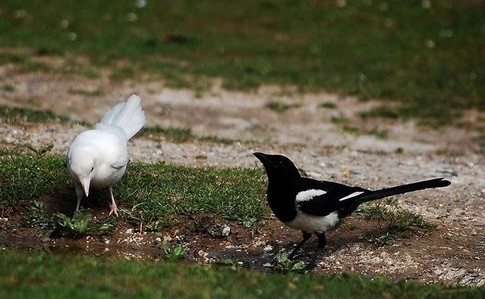
The Albino Magpie: A Rare Feathered Anomaly in the Avian World


Bird Information
The Albino Magpie: A Rare Feathered Anomaly in the Avian World

Albino magpies, though occasionally spotted in urban and rural areas worldwide, are genetic oddities that stand out starkly from their black-and-white counterparts. Caused by a recessive gene mutation that inhibits melanin production, these birds exhibit pure white plumage, pinkish legs, and striking red or pale blue eyes—a result of blood vessels reflecting through unpigmented tissues. Unlike leucistic magpies (which have partial color loss), albinos lack all pigmentation, making them a rare sight in the wild.

Survival Challenges in a Monochrome Coat

  • Camouflage Compromise
    A magpie’s typical black-and-white plumage serves as effective camouflage in diverse habitats, but albinism strips this advantage. White feathers make them conspicuous to predators like hawks and cats, while reduced vision from light-sensitive eyes (photophobia) hinders their ability to spot threats. In urban areas, they may face additional risks from traffic or human curiosity.
  • Social and Behavioral Impacts
    Albino magpies often struggle with social integration. Magpies are highly social birds, but unusual coloration may lead to rejection by flocks, affecting their ability to forage or defend territories. Their survival also hinges on adaptability: some have been observed altering foraging times to avoid bright sunlight, relying more on memory and auditory cues to navigate.

Scientific and Cultural Perspectives

  • Genetic Curiosity
    Ornithologists value albino magpies as natural experiments, studying how pigmentation affects avian survival. In the UK, where albino Eurasian magpies (Pica pica) are occasionally recorded, researchers note that while their lifespan is shorter than normal magpies, some individuals survive to adulthood, defying odds.
  • Mythology and Folklore
    In various cultures, albino birds have been seen as omens—some consider them symbols of purity, while others view them as harbingers of misfortune. In Japanese folklore, albino crows (a similar anomaly) are linked to spiritual messages, while in Western traditions, they’ve been associated with witchcraft. Such beliefs often fuel both fascination and fear, impacting how albino magpies are perceived in the wild.


While albino magpies face significant survival challenges, their rarity underscores the diversity of genetic expression in nature. Each sighting serves as a reminder of evolution’s unpredictable twists—and the delicate balance between genetic variation and environmental adaptation in the avian world. Conservation efforts for magpies focus less on albinos specifically than on preserving overall habitat health, ensuring that even the most unusual individuals have a chance to thrive.

Latest Stories
Feline News2 minute readOriginating from the northwestern United States, the Pixiebob Longhair has captivated cat enthusiasts worldwide with its striking resemblance to the wild bobcat and its loyal, affectionate nature. As the long-haired variant of the Pixiebob breed, this "native new breed"—recognized by The International Cat Association (TICA)—boasts a robust physique, luxurious silky coat, and a uniquely bobbed tail, earning accolades in international cat shows.
Animal Information1 minute readOriginating in Hungary, the Komondor is a muscular large breed renowned as a fearless guardian. Historically tasked with protecting herds from wolves, this agile canine now serves as a devoted family guard dog, blending loyalty with a distinctive appearance that earned it a quirky nickname.
Feline News2 minute readThe Turkish Angora, a breed steeped in history and elegance, has captivated hearts for centuries with its striking appearance and regal demeanor. Originating from Ankara, Turkey (formerly Angora), this ancient longhair breed is believed to be the ancestor of many modern longhaired cats. Once on the brink of extinction, it was saved by dedicated conservation efforts, including a 1930s breeding program initiated by the Turkish government, which focused on preserving the iconic white-coated variety. Today, it stands as a national treasure, celebrated for its beauty and cultural significance.
Animal Information1 minute readThe humphead wrasse (Cheilinus undulatus), a majestic marine species, remains listed as endangered, facing ongoing threats to its survival in global oceans. Renowned for its impressive size, adult individuals can reach a staggering weight of 180 kilograms, making it one of the largest reef-dwelling fish in the world.
Feline News1 minute readThe Balinese cat, also known as the Bali cat or Java cat, is a charming medium - sized long - haired cat. It originated in the United States and is a long - haired mutant of the Siamese cat. It is named the Balinese cat because its movements are 酷似 those of the native Balinese dancers.
Animal Information1 minute readThe global population of Bengal tigers currently stands at approximately 24,000, but a closer look at the figures reveals a worrying reality: only around 3,200 of these majestic creatures live in their natural wild habitats, while nearly 20,000 are in captivity. This stark contrast becomes even more alarming when compared to historical records.
Animal Information1 minute readThe Atossa fritillary (Speyeria adiaste atossa), a butterfly once common in Southern California’s mountain regions, is feared extinct, with no confirmed sightings since 1959. Characterized by its broad wings decorated with elegant black spots, the species once thrived across the area’s rugged landscapes.