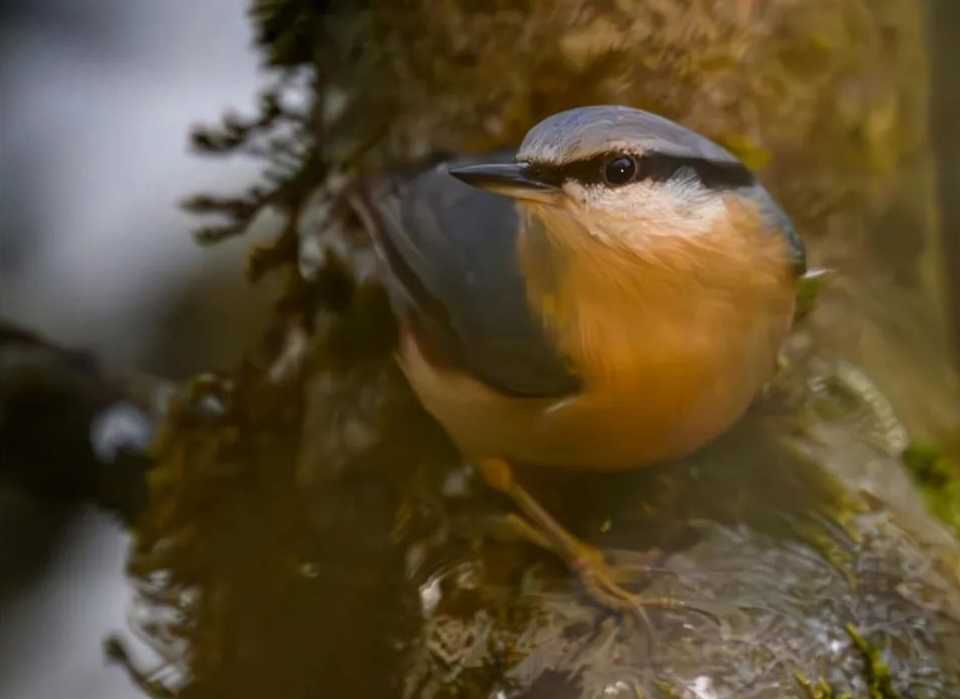
The Agile and Adaptable Eurasian Nuthatch


Bird Information
The Agile and Adaptable Eurasian Nuthatch

The Eurasian Nuthatch (Sitta europaea) is a small yet captivating bird that has captured the attention of bird enthusiasts across its vast range. Found in the woodlands of Europe and Asia, this species stands out for its unique behaviors and charming appearance.


Measuring around 12 - 15 centimeters in length, the Eurasian Nuthatch presents a distinct look. Its upperparts are adorned with a beautiful blue - gray plumage, which provides excellent camouflage among the tree branches. A bold black stripe runs through its eye, adding a touch of elegance to its face. The underparts vary in color among different subspecies, ranging from a soft, pale buff to a more vibrant orange - brown. This little bird has a short tail and a stout, pointed bill, perfectly designed for its foraging habits. It also possesses strong feet with sharp claws, enabling it to cling to tree trunks and branches, and it's the only tree - climbing bird that can move head - first down a tree trunk, a skill that sets it apart.


These nuthatches are highly adaptable when it comes to habitats. They thrive in mature deciduous and mixed forests, where large, old trees provide an abundance of food and suitable nesting sites. Their diet is diverse, consisting mainly of insects such as caterpillars, beetles, and spiders during the warmer months. In autumn and winter, they switch to a diet rich in nuts and seeds, which they often hoard in tree crevices for later consumption. This hoarding behavior helps them survive the leaner winter periods. They are social birds, often seen in small groups or pairs, and communicate with a series of sharp, high - pitched calls, like the distinct "dwip - dwip" sound.


During the breeding season, the Eurasian Nuthatch shows great ingenuity. Pairs select tree holes, often those left behind by woodpeckers, to build their nests. If the entrance is too large, the female will plaster it with mud to make it more secure and reduce the risk of predators entering. Inside, they line the nest with soft materials like bark flakes and feathers. The female lays a clutch of 6 - 9 eggs, which are incubated by both parents. Once the chicks hatch, they are fed a diet mainly of insects, ensuring their rapid growth. Although they face some threats from habitat loss due to deforestation and woodland fragmentation, their wide distribution and adaptability have allowed their population to remain stable for now. As a result, they are currently classified as a species of least concern by the IUCN. The Eurasian Nuthatch continues to enchant observers with its acrobatic foraging skills and plays an important role in maintaining the ecological balance of forest ecosystems.

Latest Stories
Feline News2 minute readOriginating from the northwestern United States, the Pixiebob Longhair has captivated cat enthusiasts worldwide with its striking resemblance to the wild bobcat and its loyal, affectionate nature. As the long-haired variant of the Pixiebob breed, this "native new breed"—recognized by The International Cat Association (TICA)—boasts a robust physique, luxurious silky coat, and a uniquely bobbed tail, earning accolades in international cat shows.
Animal Information1 minute readOriginating in Hungary, the Komondor is a muscular large breed renowned as a fearless guardian. Historically tasked with protecting herds from wolves, this agile canine now serves as a devoted family guard dog, blending loyalty with a distinctive appearance that earned it a quirky nickname.
Feline News2 minute readThe Turkish Angora, a breed steeped in history and elegance, has captivated hearts for centuries with its striking appearance and regal demeanor. Originating from Ankara, Turkey (formerly Angora), this ancient longhair breed is believed to be the ancestor of many modern longhaired cats. Once on the brink of extinction, it was saved by dedicated conservation efforts, including a 1930s breeding program initiated by the Turkish government, which focused on preserving the iconic white-coated variety. Today, it stands as a national treasure, celebrated for its beauty and cultural significance.
Animal Information1 minute readThe humphead wrasse (Cheilinus undulatus), a majestic marine species, remains listed as endangered, facing ongoing threats to its survival in global oceans. Renowned for its impressive size, adult individuals can reach a staggering weight of 180 kilograms, making it one of the largest reef-dwelling fish in the world.
Feline News1 minute readThe Balinese cat, also known as the Bali cat or Java cat, is a charming medium - sized long - haired cat. It originated in the United States and is a long - haired mutant of the Siamese cat. It is named the Balinese cat because its movements are 酷似 those of the native Balinese dancers.
Animal Information1 minute readThe global population of Bengal tigers currently stands at approximately 24,000, but a closer look at the figures reveals a worrying reality: only around 3,200 of these majestic creatures live in their natural wild habitats, while nearly 20,000 are in captivity. This stark contrast becomes even more alarming when compared to historical records.
Animal Information1 minute readThe Atossa fritillary (Speyeria adiaste atossa), a butterfly once common in Southern California’s mountain regions, is feared extinct, with no confirmed sightings since 1959. Characterized by its broad wings decorated with elegant black spots, the species once thrived across the area’s rugged landscapes.