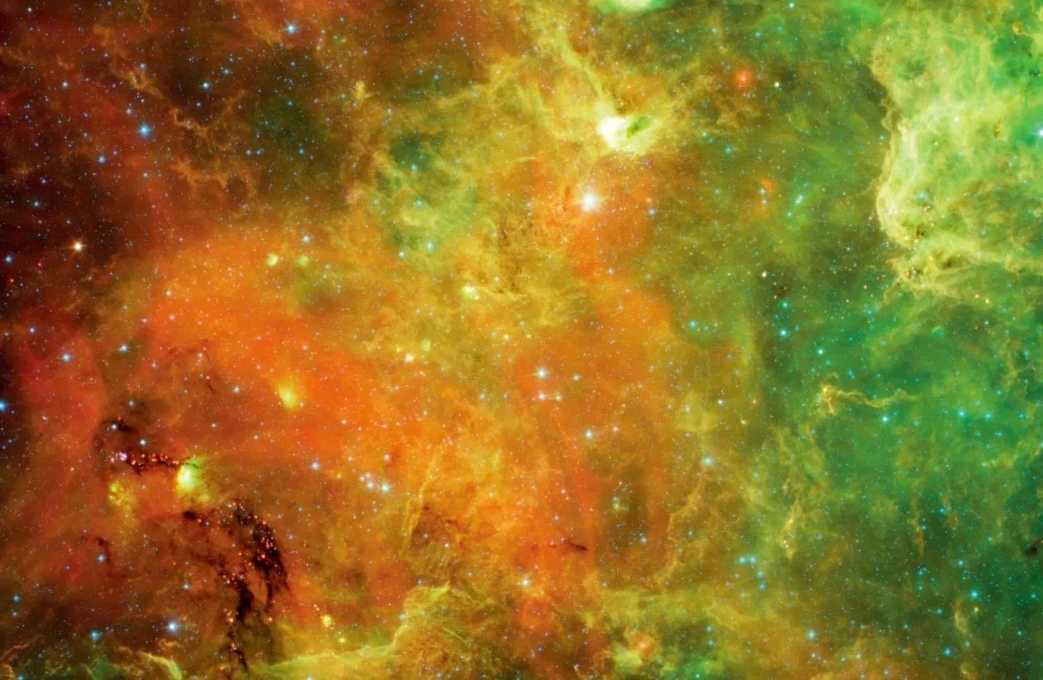
A striking image from NASA’s Spitzer Space Telescope captures the North America Nebula (NGC 7000) in infrared light, revealing a cosmic landscape brimming with massive gas clouds and hidden stellar nurseries. Unlike visible-light views, which often show only the nebula’s glowing outer edges, Spitzer’s infrared detectors penetrate the dense dust, exposing the complex interplay of gas, dust, and young stars within this vast stellar nursery.
Located approximately 1,500 light-years from Earth in the constellation Cygnus, the North America Nebula earns its name from its resemblance to the continent’s outline in visible-light images, with a "peninsula" resembling Florida and a "gulf" region. In Spitzer’s infrared data, however, the nebula’s true complexity emerges. The telescope’s sensitive infrared arrays detect heat emitted by dust particles warmed by young stars, allowing astronomers to map regions where star formation is actively underway. The image highlights bright clumps and filaments of dust, each potentially harboring protostars—newborn stars still shrouded in their natal clouds of gas and dust. These hidden embryos, invisible in visible light, are the future stars that will shape the nebula’s evolution.
The nebula’s infrared glow also traces the distribution of molecular hydrogen and polycyclic aromatic hydrocarbons (PAHs), organic molecules commonly found in interstellar space. These components, illuminated by the ultraviolet radiation from nearby O and B-type stars, emit infrared light as they cool, creating the nebula’s warm, ethereal hues. Spitzer’s data reveal that the North America Nebula is part of a larger complex of gas and dust, including its neighboring Pelican Nebula (IC 5070), collectively forming one of the closest and most active star-forming regions to Earth.
For astronomers, infrared observations like those from Spitzer are indispensable for studying the earliest stages of stellar birth. Dust clouds that obscure visible light are transparent to infrared radiation, allowing researchers to count the number of young stars, measure their masses, and track their interactions with the surrounding gas. This information helps refine models of star formation, including how gravitational collapse, stellar winds, and supernova explosions influence the lifecycle of nebulae. The North America Nebula, as seen through Spitzer’s eyes, is not just a pretty cosmic portrait but a dynamic laboratory for understanding how galaxies assemble their stellar populations and recycle material through the interstellar medium.
As one of the first space-based observatories dedicated to infrared astronomy, Spitzer has revolutionized our view of the universe, uncovering hidden wonders like the North America Nebula’s secret stellar nurseries. This image serves as a reminder of the cosmos’s layered complexity—what appears as a simple glowing cloud in visible light transforms into a vibrant, chaotic ecosystem of star birth and evolution when viewed through the lens of infrared science.