Neptune: The Mysterious Ice Giant on the Solar System's Fringe


Astro Information
Neptune: The Mysterious Ice Giant on the Solar System's Fringe

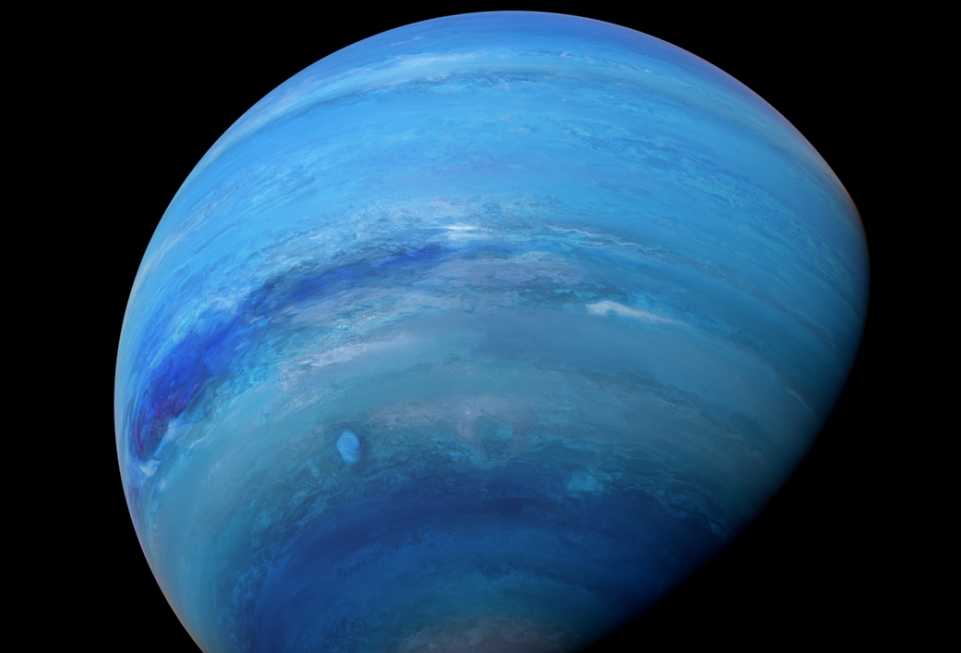
Neptune, the eighth and most distant planet from the Sun in our solar system, remains a captivating enigma. Hidden from the naked eye, this ice giant reveals a world of extremes, with its unique features and dynamic atmosphere offering a glimpse into the far - reaches of our cosmic neighborhood.


With an average distance of about 4.5 billion kilometers from the Sun, Neptune takes a staggering 164.8 Earth years to complete one orbit. Its equatorial diameter measures around 49,244 kilometers, making it nearly four times wider than Earth. The planet is named after the Roman god of the sea, a fitting moniker considering its deep blue appearance, which comes from the methane in its atmosphere absorbing red light. Neptune's atmosphere is mainly composed of hydrogen and helium, with a small but significant amount of methane. This mix, along with an unknown atmospheric gas, gives the planet its vivid, bright blue color. Through a small telescope, it appears as a tiny, faint blue - green disk.


Beneath its gaseous exterior, Neptune likely has a core of rock and ice, surrounded by a mantle of hot, dense fluids made up of water, ammonia, and methane ices. The planet's interior is a high - pressure, high - temperature environment, with the core reaching temperatures of approximately 5,400 K (5,100 °C; 9,300 °F). Neptune also has a complex and active atmosphere. It features some of the strongest winds in the solar system, with speeds reaching up to 2,100 km/h (1,300 mph). These winds drive large - scale storms, such as the Great Dark Spot observed by Voyager 2 in 1989, a storm system about the size of Earth. In 2018, new dark spots were identified, highlighting the planet's ever - changing weather patterns. Additionally, in 2023, the James Webb Space Telescope made history by capturing the first images of Neptune's auroras, which are irregularly shaped and closer to the planet's equator due to its unique magnetic field, with the magnetic poles offset from the rotational axis.


Neptune has 14 known moons, with Triton being the largest and most fascinating. Discovered just 17 days after Neptune itself in 1846, Triton is unique in that it orbits Neptune in a retrograde direction, opposite to the planet's rotation. This suggests that Triton may have been a Kuiper Belt object captured by Neptune's gravity. Triton is extremely cold, with surface temperatures around -235 °C (-391 °F), yet it has active geysers that spew icy material. The planet also has a faint and fragmented ring system, discovered in 1984 and confirmed by Voyager 2. These rings, along with the planet's moons and dynamic atmosphere, continue to intrigue scientists, who hope to unlock more of Neptune's secrets through future space missions and advanced telescopic observations.
Latest Stories
Feline News2 minute readOriginating from the northwestern United States, the Pixiebob Longhair has captivated cat enthusiasts worldwide with its striking resemblance to the wild bobcat and its loyal, affectionate nature. As the long-haired variant of the Pixiebob breed, this "native new breed"—recognized by The International Cat Association (TICA)—boasts a robust physique, luxurious silky coat, and a uniquely bobbed tail, earning accolades in international cat shows.
Animal Information1 minute readOriginating in Hungary, the Komondor is a muscular large breed renowned as a fearless guardian. Historically tasked with protecting herds from wolves, this agile canine now serves as a devoted family guard dog, blending loyalty with a distinctive appearance that earned it a quirky nickname.
Feline News2 minute readThe Turkish Angora, a breed steeped in history and elegance, has captivated hearts for centuries with its striking appearance and regal demeanor. Originating from Ankara, Turkey (formerly Angora), this ancient longhair breed is believed to be the ancestor of many modern longhaired cats. Once on the brink of extinction, it was saved by dedicated conservation efforts, including a 1930s breeding program initiated by the Turkish government, which focused on preserving the iconic white-coated variety. Today, it stands as a national treasure, celebrated for its beauty and cultural significance.
Animal Information1 minute readThe humphead wrasse (Cheilinus undulatus), a majestic marine species, remains listed as endangered, facing ongoing threats to its survival in global oceans. Renowned for its impressive size, adult individuals can reach a staggering weight of 180 kilograms, making it one of the largest reef-dwelling fish in the world.
Feline News1 minute readThe Balinese cat, also known as the Bali cat or Java cat, is a charming medium - sized long - haired cat. It originated in the United States and is a long - haired mutant of the Siamese cat. It is named the Balinese cat because its movements are 酷似 those of the native Balinese dancers.
Animal Information1 minute readThe global population of Bengal tigers currently stands at approximately 24,000, but a closer look at the figures reveals a worrying reality: only around 3,200 of these majestic creatures live in their natural wild habitats, while nearly 20,000 are in captivity. This stark contrast becomes even more alarming when compared to historical records.
Animal Information1 minute readThe Atossa fritillary (Speyeria adiaste atossa), a butterfly once common in Southern California’s mountain regions, is feared extinct, with no confirmed sightings since 1959. Characterized by its broad wings decorated with elegant black spots, the species once thrived across the area’s rugged landscapes.