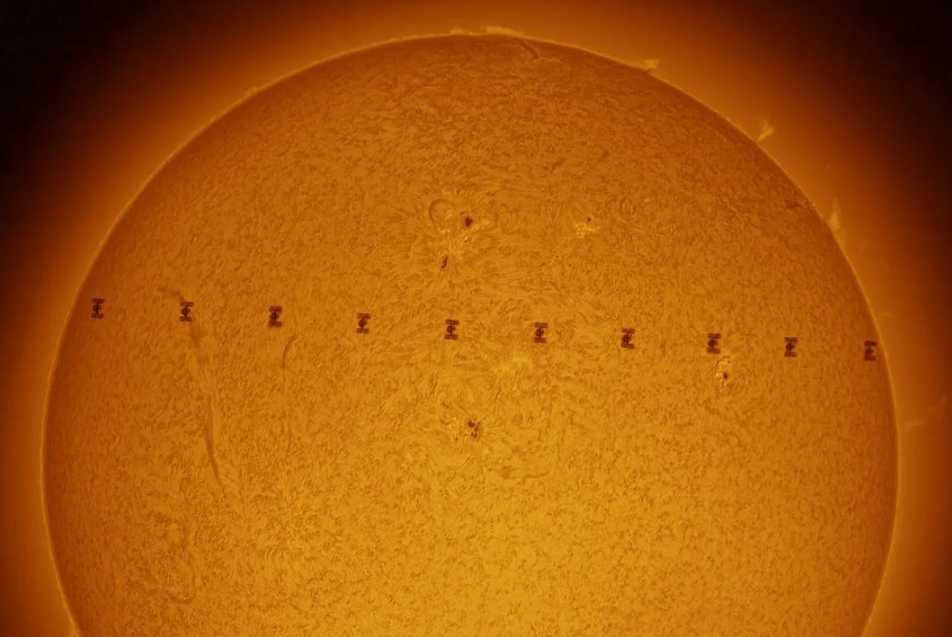
The International Space Station Transit: A Fleeting Solar Spectacle


Astro Information
The International Space Station Transit: A Fleeting Solar Spectacle

When the International Space Station (ISS) streaks across the Sun’s disk at 8 km/s, its 0.8-second transit freezes human ingenuity and stellar dynamics on the same cosmic canvas. This rare phenomenon defies the ISS’s usual visibility—typically a bright speck in twilight—occurring only when orbital mechanics align the station, Earth, and Sun with precision.

From "Celestial Speck" to Silhouette: The Science of Visibility

  • Normal Observation: The ISS shines by reflecting sunlight, visible for 30 minutes after sunset or before sunrise when it orbits outside Earth’s shadow. At magnitude -4, it outshines Jupiter, appearing as a 匀速 moving dot.
  • Transit Anomaly: During a transit, the ISS blocks sunlight, forming a silhouette. This requires daytime visibility and a strict alignment of the station’s orbit with the Sun’s disk—occurring only a few times annually over narrow ground paths (e.g., the 200m-wide window in Sant Feliu de Buixelleu, Spain).

The 0.8-Second Shutter Challenge: Technology Behind the Capture

Photographing the transit demands three technical feats:


  1. Equipment Precision: 1/1000+ second exposure cameras with H-α filters to shield against solar glare.
  2. Orbital Prediction: NASA’s Spot the Station tool calculates ISS trajectories with sub-second accuracy.
  3. Image Synthesis: This composite merges:
    • Multiple transit frames (capturing the ISS’s T-shaped outline of solar panels and modules).
    • High-res solar activity data (overlaying details like magnetic loops in active regions and chromospheric prominences).


Note: Prominences are 100,000°C plasma arcs extending tens of thousands of km, glowing red in H-α filters.

A Double Exposure of Science and Art

The composite reveals:


  • Active Region Jets: Dark sunspot groups unleash high-energy particles at hundreds of km/s.
  • Prominence Magnetism: Arc-shaped structures trace magnetic fields trapping plasma, evolving with solar dynamics.
  • Orbital Validation: The silhouette’s scale confirms the ISS’s 400km altitude, verifying astrodynamic models.

Extending the Cosmic Ruler: Transits as Scientific Tools

From Venus transits (used to measure the Astronomical Unit in 1761) to exoplanet detections via transit photometry, these events serve as cosmic yardsticks. The ISS transit adds to this legacy: atmospheric turbulence blurs the silhouette, providing data for telescope site 评估.


This Spanish composite—blending steel machinery with a 1.4 million km-diameter star—encapsulates humanity’s place in the cosmos: a 420-ton spacecraft, tiny against the Sun, yet luminous through engineered design.
Latest Stories
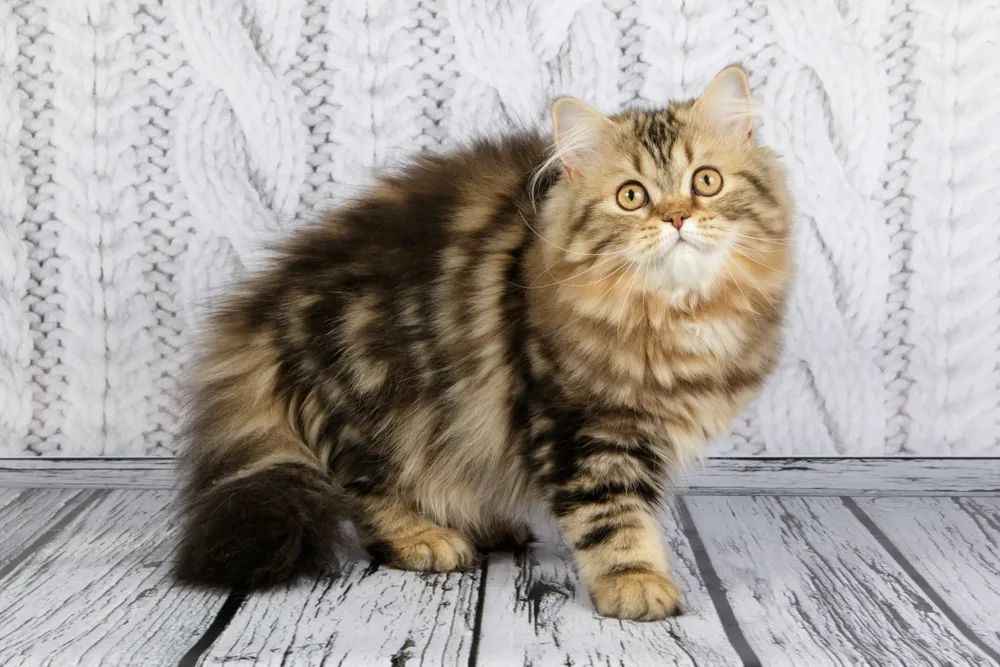
Feline News2 minute readOriginating from the northwestern United States, the Pixiebob Longhair has captivated cat enthusiasts worldwide with its striking resemblance to the wild bobcat and its loyal, affectionate nature. As the long-haired variant of the Pixiebob breed, this "native new breed"—recognized by The International Cat Association (TICA)—boasts a robust physique, luxurious silky coat, and a uniquely bobbed tail, earning accolades in international cat shows.
Animal Information1 minute readOriginating in Hungary, the Komondor is a muscular large breed renowned as a fearless guardian. Historically tasked with protecting herds from wolves, this agile canine now serves as a devoted family guard dog, blending loyalty with a distinctive appearance that earned it a quirky nickname.
Feline News2 minute readThe Turkish Angora, a breed steeped in history and elegance, has captivated hearts for centuries with its striking appearance and regal demeanor. Originating from Ankara, Turkey (formerly Angora), this ancient longhair breed is believed to be the ancestor of many modern longhaired cats. Once on the brink of extinction, it was saved by dedicated conservation efforts, including a 1930s breeding program initiated by the Turkish government, which focused on preserving the iconic white-coated variety. Today, it stands as a national treasure, celebrated for its beauty and cultural significance.
Animal Information1 minute readThe humphead wrasse (Cheilinus undulatus), a majestic marine species, remains listed as endangered, facing ongoing threats to its survival in global oceans. Renowned for its impressive size, adult individuals can reach a staggering weight of 180 kilograms, making it one of the largest reef-dwelling fish in the world.
Feline News1 minute readThe Balinese cat, also known as the Bali cat or Java cat, is a charming medium - sized long - haired cat. It originated in the United States and is a long - haired mutant of the Siamese cat. It is named the Balinese cat because its movements are 酷似 those of the native Balinese dancers.
Animal Information1 minute readThe global population of Bengal tigers currently stands at approximately 24,000, but a closer look at the figures reveals a worrying reality: only around 3,200 of these majestic creatures live in their natural wild habitats, while nearly 20,000 are in captivity. This stark contrast becomes even more alarming when compared to historical records.
Animal Information1 minute readThe Atossa fritillary (Speyeria adiaste atossa), a butterfly once common in Southern California’s mountain regions, is feared extinct, with no confirmed sightings since 1959. Characterized by its broad wings decorated with elegant black spots, the species once thrived across the area’s rugged landscapes.