The Happy Face Spider: Hawaii’s Cryptic Arthropod with a Smiling Survival Strategy


Animal Information
The Happy Face Spider: Hawaii’s Cryptic Arthropod with a Smiling Survival Strategy

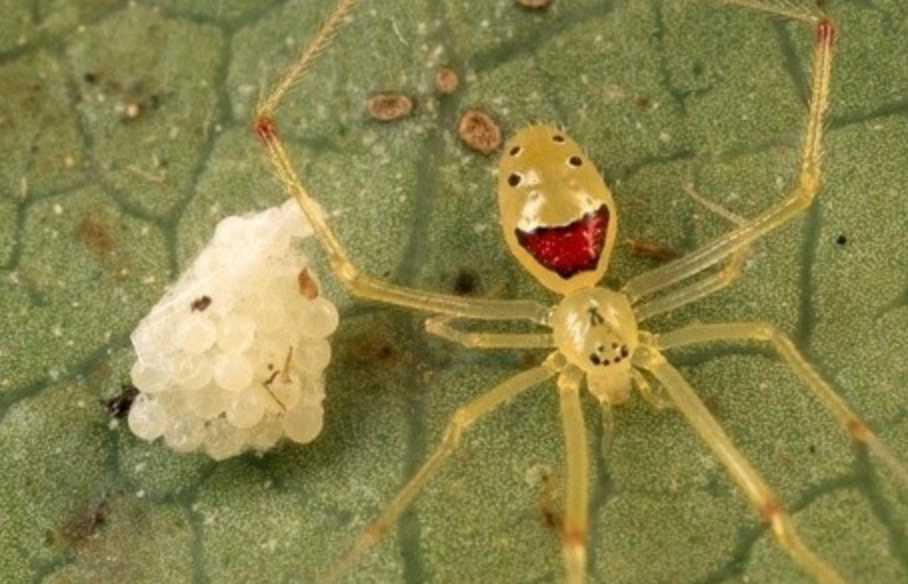
Endemic to the rainforests of Hawaii, the happy face spider (Theridion grallator) is a tiny arachnid celebrated for its most whimsical trait—a ventral abdomen marked with patterns resembling a smiling face. Discovered in the 19th century, this cryptic spider has captivated entomologists with its unique coloration and the evolutionary mystery behind its cheerful design.

A Smiley Mark in the Canopy: Physical Traits

  • Miniature Marvel with Variable Patterns
    Females measure just 5–8 mm, while males are slightly smaller, with long, spindly legs adapted for web-building in fern fronds and leaf litter. The abdomen’s "smile" consists of yellow or orange markings bordered by black lines, forming eye-like spots and a curved mouth. Patterns vary widely—some resemble bold smiles, others faint frowns or abstract designs—though the exact cause of this variation remains unclear.
  • Camouflage and Warning Coloration
    The spider’s dorsal side is typically pale green or brown, blending with foliage, while the bright ventral patterns may serve as aposematic (warning) coloration to deter predators. However, the "smile" also confuses birds or lizards, directing attacks to the non-vital abdomen rather than the head.

Life Cycle and Island Adaptations

  • Webbing and Prey
    Happy face spiders build tangled orb webs in the understory, trapping small insects like gnats and flies. They hang upside-down in their webs, displaying the abdominal pattern to potential threats. Females lay eggs in silk sacs, guarding them until hatchlings disperse via "ballooning"—releasing silk threads to catch the wind.
  • Hawaiian Endemism
    Found only on the islands of Oahu, Maui, Molokai, and Hawaii, this spider is a product of Hawaii’s isolated evolution. Its closest relatives are found in Australia, suggesting a distant ancestral migration. The species thrives in moist, native forests, relying on specific plant hosts for web attachment.

Conservation and Cultural Significance

  • Threats to a Cheerful Existence
    Listed as "Vulnerable" due to habitat loss from deforestation and invasive species (e.g., ants and spiders that compete for resources), the happy face spider faces risks from climate change and tourism. Its dependence on native Hawaiian plants makes it especially susceptible to ecosystem degradation.
  • Symbol of Aloha and Scientific Wonder
    In Hawaiian culture, the spider’s smile is seen as a symbol of joy and resilience, while scientists study its color genetics to understand how patterns evolve in isolated populations. Its discovery has also highlighted the importance of protecting Hawaii’s unique invertebrate fauna, many of which exist nowhere else on Earth.


With its tiny, grinning abdomen, the happy face spider serves as a reminder of nature’s playful side—an evolutionary joke written in pigment on the body of a creature barely visible to the naked eye. In the lush rainforests of Hawaii, this little arachnid proves that even in the most competitive ecosystems, a touch of whimsy can be the key to survival.

Latest Stories
Feline News2 minute readOriginating from the northwestern United States, the Pixiebob Longhair has captivated cat enthusiasts worldwide with its striking resemblance to the wild bobcat and its loyal, affectionate nature. As the long-haired variant of the Pixiebob breed, this "native new breed"—recognized by The International Cat Association (TICA)—boasts a robust physique, luxurious silky coat, and a uniquely bobbed tail, earning accolades in international cat shows.
Animal Information1 minute readOriginating in Hungary, the Komondor is a muscular large breed renowned as a fearless guardian. Historically tasked with protecting herds from wolves, this agile canine now serves as a devoted family guard dog, blending loyalty with a distinctive appearance that earned it a quirky nickname.
Feline News2 minute readThe Turkish Angora, a breed steeped in history and elegance, has captivated hearts for centuries with its striking appearance and regal demeanor. Originating from Ankara, Turkey (formerly Angora), this ancient longhair breed is believed to be the ancestor of many modern longhaired cats. Once on the brink of extinction, it was saved by dedicated conservation efforts, including a 1930s breeding program initiated by the Turkish government, which focused on preserving the iconic white-coated variety. Today, it stands as a national treasure, celebrated for its beauty and cultural significance.
Animal Information1 minute readThe humphead wrasse (Cheilinus undulatus), a majestic marine species, remains listed as endangered, facing ongoing threats to its survival in global oceans. Renowned for its impressive size, adult individuals can reach a staggering weight of 180 kilograms, making it one of the largest reef-dwelling fish in the world.
Feline News1 minute readThe Balinese cat, also known as the Bali cat or Java cat, is a charming medium - sized long - haired cat. It originated in the United States and is a long - haired mutant of the Siamese cat. It is named the Balinese cat because its movements are 酷似 those of the native Balinese dancers.
Animal Information1 minute readThe global population of Bengal tigers currently stands at approximately 24,000, but a closer look at the figures reveals a worrying reality: only around 3,200 of these majestic creatures live in their natural wild habitats, while nearly 20,000 are in captivity. This stark contrast becomes even more alarming when compared to historical records.
Animal Information1 minute readThe Atossa fritillary (Speyeria adiaste atossa), a butterfly once common in Southern California’s mountain regions, is feared extinct, with no confirmed sightings since 1959. Characterized by its broad wings decorated with elegant black spots, the species once thrived across the area’s rugged landscapes.