The Eye - Catching Great - Tailed Grackle: A Social Avian Sensation


Bird Information
The Eye - Catching Great - Tailed Grackle: A Social Avian Sensation

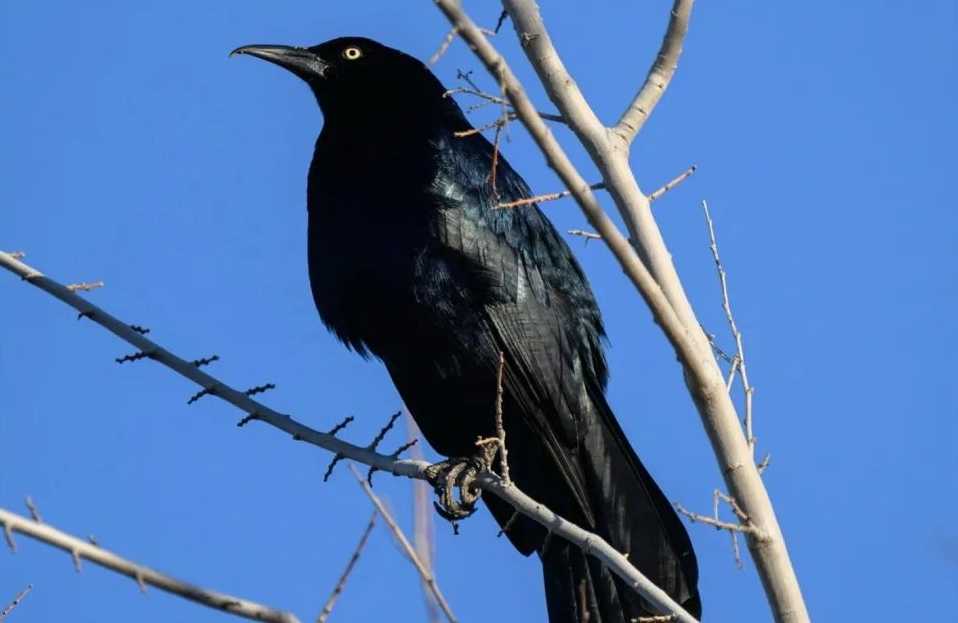
The Great - Tailed Grackle (Quiscalus mexicanus) is a remarkable bird species that has captured the attention of birdwatchers and nature enthusiasts alike. This medium - sized passerine, native to the Americas, is known for its distinct appearance and lively behavior.


Measuring 38 - 46 cm in length, with males weighing 203 - 265 g and females 115 - 142 g, the Great - Tailed Grackle exhibits significant sexual dimorphism. Males are a sight to behold, with their iridescent black plumage that shimmers in purple - blue hues on the head and upper body. Their long, keel - shaped tails, which can be folded vertically, are nearly as long as their bodies. Their bright yellow eyes add a touch of vibrancy to their imposing look. Females, on the other hand, are much smaller and have a more understated brown plumage, with darker wings and tails. Juveniles of both sexes sport brown eyes and plumage similar to females, though with streaks on the breast.


These highly social birds have a wide - ranging habitat. They can be found in a variety of open and semi - open areas, from agricultural fields and feedlots to suburban lawns, golf courses, and city parks. Their range has expanded significantly over the years. Originating from the tropical lowlands of Central and South America, they have spread northwards following urban and agricultural corridors. Today, their territory stretches from northwestern Venezuela and western Colombia and Ecuador in the south, all the way to Minnesota in the north, and from the west coast states like Oregon, Idaho, and California to Florida in the east. Vagrants have even been spotted as far north as southern Canada.


Great - Tailed Grackles are omnivores with diverse foraging habits. They peck at the ground in search of insects, larvae, and seeds. They also wade into shallow water to catch tadpoles, fish, and crustaceans. Additionally, they are not averse to raiding the nests of other birds for eggs and nestlings. During the breeding season, which usually starts in early or mid - April, males put on elaborate displays to attract females. Territorial males defend their areas where multiple females build their nests using woven grass, twigs, and sometimes man - made materials. Females lay 4 - 7 eggs, which they incubate for about 13 - 14 days. The young leave the nest 12 - 17 days after hatching but continue to be fed by their parents for several weeks. Despite being considered pests in some areas due to their habit of eating young crops and fruits, they play an important role in the ecosystem, and their population remains stable, classified as a species of least concern by the IUCN.
Latest Stories
Feline News2 minute readOriginating from the northwestern United States, the Pixiebob Longhair has captivated cat enthusiasts worldwide with its striking resemblance to the wild bobcat and its loyal, affectionate nature. As the long-haired variant of the Pixiebob breed, this "native new breed"—recognized by The International Cat Association (TICA)—boasts a robust physique, luxurious silky coat, and a uniquely bobbed tail, earning accolades in international cat shows.
Animal Information1 minute readOriginating in Hungary, the Komondor is a muscular large breed renowned as a fearless guardian. Historically tasked with protecting herds from wolves, this agile canine now serves as a devoted family guard dog, blending loyalty with a distinctive appearance that earned it a quirky nickname.
Feline News2 minute readThe Turkish Angora, a breed steeped in history and elegance, has captivated hearts for centuries with its striking appearance and regal demeanor. Originating from Ankara, Turkey (formerly Angora), this ancient longhair breed is believed to be the ancestor of many modern longhaired cats. Once on the brink of extinction, it was saved by dedicated conservation efforts, including a 1930s breeding program initiated by the Turkish government, which focused on preserving the iconic white-coated variety. Today, it stands as a national treasure, celebrated for its beauty and cultural significance.
Animal Information1 minute readThe humphead wrasse (Cheilinus undulatus), a majestic marine species, remains listed as endangered, facing ongoing threats to its survival in global oceans. Renowned for its impressive size, adult individuals can reach a staggering weight of 180 kilograms, making it one of the largest reef-dwelling fish in the world.
Feline News1 minute readThe Balinese cat, also known as the Bali cat or Java cat, is a charming medium - sized long - haired cat. It originated in the United States and is a long - haired mutant of the Siamese cat. It is named the Balinese cat because its movements are 酷似 those of the native Balinese dancers.
Animal Information1 minute readThe global population of Bengal tigers currently stands at approximately 24,000, but a closer look at the figures reveals a worrying reality: only around 3,200 of these majestic creatures live in their natural wild habitats, while nearly 20,000 are in captivity. This stark contrast becomes even more alarming when compared to historical records.
Animal Information1 minute readThe Atossa fritillary (Speyeria adiaste atossa), a butterfly once common in Southern California’s mountain regions, is feared extinct, with no confirmed sightings since 1959. Characterized by its broad wings decorated with elegant black spots, the species once thrived across the area’s rugged landscapes.