Scorpionflies: The Insects with a Deceptive 'Scorpion Tail'


Insect Information
Scorpionflies: The Insects with a Deceptive 'Scorpion Tail'

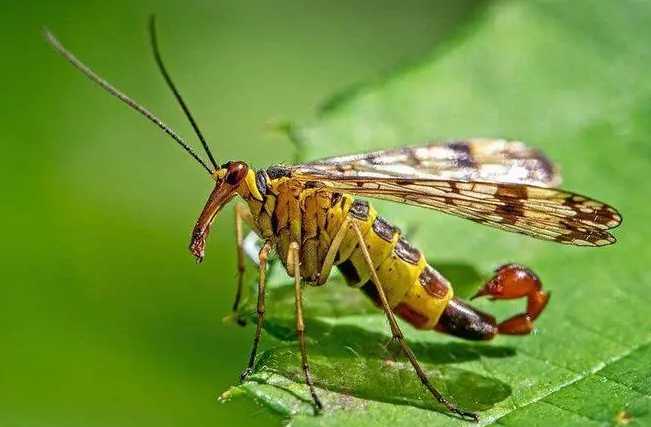
In forests and meadows worldwide, scorpionflies (order Mecoptera) perplex onlookers with a curious feature: a tail that resembles a scorpion’s stinger, but serves an entirely different purpose. Contrary to appearances, this bulbous, curved appendage at the insect’s rear is not a venomous weapon—but rather the male’s elaborate genitalia, a bizarre evolutionary trait that has fascinated entomologists for centuries.


A Misleading Appendage: Form vs. Function
The male scorpionfly’s "tail" is actually an enlarged, segmented abdomen modified into a clasping organ used during mating. Resembling a scorpion’s stinger in shape and positioning, it can curl upward in a threatening pose, yet lacks any venom glands or piercing ability. This mimicry is thought to deter predators, as the illusion of a scorpion’s sting may dissuade birds or small mammals from attacking. Females, meanwhile, have straight, unspecialized abdomens, highlighting the dramatic sexual dimorphism in the species. Despite their intimidating appearance, scorpionflies are harmless to humans, feeding primarily on decaying plant matter, small insects, and even carrion.


Behavior and Evolutionary Significance
Scorpionflies are named for their scorpion-like tail and fly-like wings, which fold over their bodies at rest. During courtship, males use their genitalic "tail" to grasp females, while some species offer nuptial gifts of saliva or prey to attract mates—a behavior rare in insects. Their unique morphology provides insights into evolutionary biology, as the scorpion tail mimicry exemplifies how sexual selection and predator avoidance can shape bizarre traits. Found in temperate regions, they play a role in ecosystems as decomposers and pollinators, though their secretive nature makes them easy to overlook.


For researchers, scorpionflies serve as a reminder that nature’s designs often prioritize survival and reproduction over straightforward functionality. Their deceptive "stinger" proves that in the insect world, even the most fearsome-looking features may hide a surprising purpose. As these quirky insects flutter through the underbrush, their existence challenges our assumptions—showing that sometimes, the most intimidating appendages are anything but weapons.
Latest Stories
Feline News2 minute readOriginating from the northwestern United States, the Pixiebob Longhair has captivated cat enthusiasts worldwide with its striking resemblance to the wild bobcat and its loyal, affectionate nature. As the long-haired variant of the Pixiebob breed, this "native new breed"—recognized by The International Cat Association (TICA)—boasts a robust physique, luxurious silky coat, and a uniquely bobbed tail, earning accolades in international cat shows.
Animal Information1 minute readOriginating in Hungary, the Komondor is a muscular large breed renowned as a fearless guardian. Historically tasked with protecting herds from wolves, this agile canine now serves as a devoted family guard dog, blending loyalty with a distinctive appearance that earned it a quirky nickname.
Feline News2 minute readThe Turkish Angora, a breed steeped in history and elegance, has captivated hearts for centuries with its striking appearance and regal demeanor. Originating from Ankara, Turkey (formerly Angora), this ancient longhair breed is believed to be the ancestor of many modern longhaired cats. Once on the brink of extinction, it was saved by dedicated conservation efforts, including a 1930s breeding program initiated by the Turkish government, which focused on preserving the iconic white-coated variety. Today, it stands as a national treasure, celebrated for its beauty and cultural significance.
Animal Information1 minute readThe humphead wrasse (Cheilinus undulatus), a majestic marine species, remains listed as endangered, facing ongoing threats to its survival in global oceans. Renowned for its impressive size, adult individuals can reach a staggering weight of 180 kilograms, making it one of the largest reef-dwelling fish in the world.
Feline News1 minute readThe Balinese cat, also known as the Bali cat or Java cat, is a charming medium - sized long - haired cat. It originated in the United States and is a long - haired mutant of the Siamese cat. It is named the Balinese cat because its movements are 酷似 those of the native Balinese dancers.
Animal Information1 minute readThe global population of Bengal tigers currently stands at approximately 24,000, but a closer look at the figures reveals a worrying reality: only around 3,200 of these majestic creatures live in their natural wild habitats, while nearly 20,000 are in captivity. This stark contrast becomes even more alarming when compared to historical records.
Animal Information1 minute readThe Atossa fritillary (Speyeria adiaste atossa), a butterfly once common in Southern California’s mountain regions, is feared extinct, with no confirmed sightings since 1959. Characterized by its broad wings decorated with elegant black spots, the species once thrived across the area’s rugged landscapes.