Saturn’s Enceladus: Does an Ocean beneath Ice Harbor Life?


Astro Information
Saturn’s Enceladus: Does an Ocean beneath Ice Harbor Life?

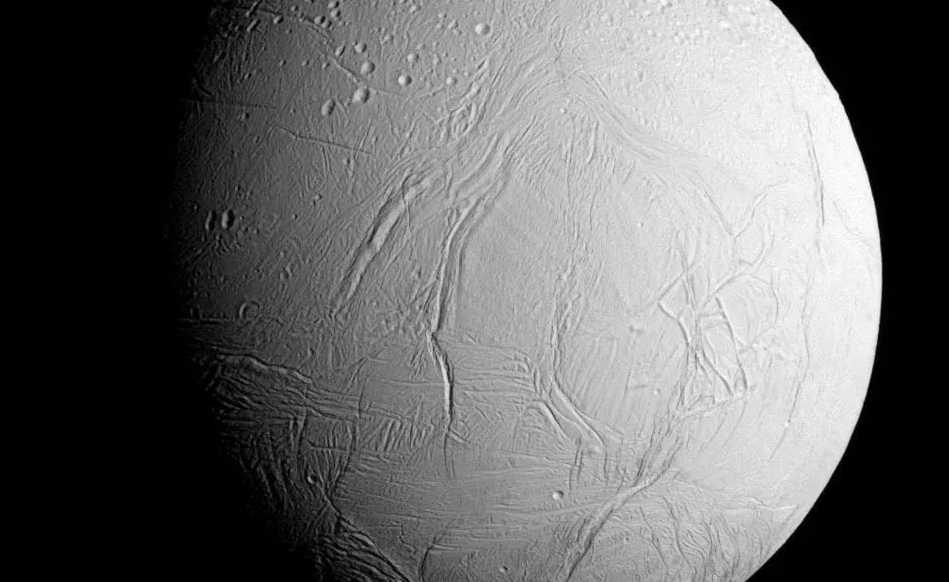
Enceladus, Saturn’s icy moon, harbors a subsurface ocean beneath tiger-stripe fractures that erupt icy particles into space. These geysers form a dense ice cloud over the south pole, feeding Saturn’s faint E ring. The Cassini spacecraft (2004–2017) provided definitive evidence, capturing this true-color, high-resolution image during a close flyby, revealing shadowed ice chasms and active vents.

Geological Mystery: Why Enceladus Thrives While Mimas Slumbers

Enceladus’ "Tiger Stripes"—four parallel fractures each 130 km long—pulse with eruptions, flinging water vapor and ice grains at 800 km/h. Unusually, this activity persists despite Enceladus’ tiny size (504 km diameter). By contrast, similar-sized Mimas lies geologically dead. Scientists suspect tidal heating from Saturn’s gravity flexes Enceladus’ core, generating the warmth needed to sustain its subsurface ocean.


Cassini’s radar revealed a 10–30 km deep ocean beneath a 30–40 km ice crust. The moon’s south pole shows recent surface resurfacing, indicating ongoing activity—unlike most icy moons, which are geologically frozen.

Organic Molecules in Eruptions: Clues to Possible Life

Analysis of Enceladus’ plume particles revealed complex organic molecules, including benzene and long-chain hydrocarbons. These carbon-rich compounds, detected in 2015 by Cassini’s mass spectrometer, are building blocks of life as we know it. While not proof of life, their presence suggests the ocean may have a habitable chemistry:


  • Warm Hydrothermal Vents: Subsurface ocean models predict hydrothermal activity at Enceladus’ seafloor, similar to Earth’s deep-sea vents where life thrives.
  • Energy Sources: Dissolved salts and chemical gradients in the ocean could provide energy for microbial life.


"Enceladus is a top target for astrobiology," says Dr. Linda Spilker, Cassini project scientist. "Its ocean has liquid water, organic materials, and energy sources—three key ingredients for life."


Future missions like NASA’s Enceladus Orbilander (proposed) aim to sample the plume directly, searching for biosignatures. Until then, Enceladus remains a cosmic enigma—an icy moon spraying hints of life into the Saturnian system.
Latest Stories
Feline News2 minute readOriginating from the northwestern United States, the Pixiebob Longhair has captivated cat enthusiasts worldwide with its striking resemblance to the wild bobcat and its loyal, affectionate nature. As the long-haired variant of the Pixiebob breed, this "native new breed"—recognized by The International Cat Association (TICA)—boasts a robust physique, luxurious silky coat, and a uniquely bobbed tail, earning accolades in international cat shows.
Animal Information1 minute readOriginating in Hungary, the Komondor is a muscular large breed renowned as a fearless guardian. Historically tasked with protecting herds from wolves, this agile canine now serves as a devoted family guard dog, blending loyalty with a distinctive appearance that earned it a quirky nickname.
Feline News2 minute readThe Turkish Angora, a breed steeped in history and elegance, has captivated hearts for centuries with its striking appearance and regal demeanor. Originating from Ankara, Turkey (formerly Angora), this ancient longhair breed is believed to be the ancestor of many modern longhaired cats. Once on the brink of extinction, it was saved by dedicated conservation efforts, including a 1930s breeding program initiated by the Turkish government, which focused on preserving the iconic white-coated variety. Today, it stands as a national treasure, celebrated for its beauty and cultural significance.
Animal Information1 minute readThe humphead wrasse (Cheilinus undulatus), a majestic marine species, remains listed as endangered, facing ongoing threats to its survival in global oceans. Renowned for its impressive size, adult individuals can reach a staggering weight of 180 kilograms, making it one of the largest reef-dwelling fish in the world.
Feline News1 minute readThe Balinese cat, also known as the Bali cat or Java cat, is a charming medium - sized long - haired cat. It originated in the United States and is a long - haired mutant of the Siamese cat. It is named the Balinese cat because its movements are 酷似 those of the native Balinese dancers.
Animal Information1 minute readThe global population of Bengal tigers currently stands at approximately 24,000, but a closer look at the figures reveals a worrying reality: only around 3,200 of these majestic creatures live in their natural wild habitats, while nearly 20,000 are in captivity. This stark contrast becomes even more alarming when compared to historical records.
Animal Information1 minute readThe Atossa fritillary (Speyeria adiaste atossa), a butterfly once common in Southern California’s mountain regions, is feared extinct, with no confirmed sightings since 1959. Characterized by its broad wings decorated with elegant black spots, the species once thrived across the area’s rugged landscapes.